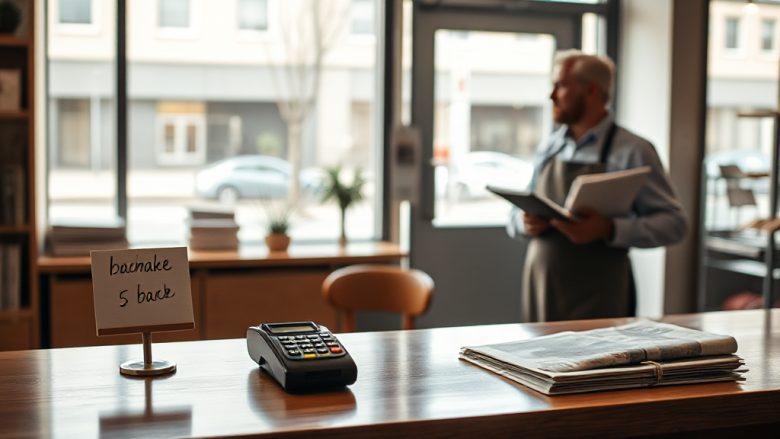
It’s 2:40 on a Tuesday afternoon. You’ve wiped the counter twice, reorganised the window display, and checked your phone more times than you’d admit. Two people walked past in the last hour. Neither came in. You’ve tried a few things already — a boosted post, a leaflet drop, a discount that felt generous at the time — and each one produced a small flurry of activity followed by silence. So where is everyone?
The honest answer is that quiet periods are rarely caused by one big failure. They’re usually the result of several small gaps stacking up: people don’t know you exist, or they know but don’t trust you yet, or they trust you but have no reason to choose today over next month. Learning how to get more customers for a local business starts with working out which of those gaps is actually costing you, rather than throwing more money at the same tactics that already underperformed.
This is a diagnostic approach. Work through it in order, and you’ll find the bottleneck rather than guessing at it.
Diagnose why customers aren’t coming through the door
Before changing anything, spend a week gathering evidence. Most owners skip this and jump straight to a new promotion, which is why results stay inconsistent.
Start with the people who already found you. Ask every customer who comes in how they heard about you. Not a formal survey — just a question at the till. After twenty or thirty answers, patterns appear. If almost everyone says “I walk past every day,” your problem is reach, not reputation. If most say “a friend told me,” your reputation is fine but your visibility is weak. If people say “I searched for a plumber near me,” then your online presence is doing the work and something else is limiting volume.
Then look at the ones who nearly came in. Check your online listings for accuracy. Wrong opening hours, a phone number that rings out, or a map pin placed on the wrong side of the road will quietly kill enquiries without you ever knowing. Search for your own business the way a stranger would, on a phone, standing outside. What do they see in the first ten seconds? If it’s an outdated photo, a three-year-old review, or no clear indication of what you actually sell, that’s your first fix.
Finally, listen for the reason people give when they don’t buy. “I’ll come back when I’ve got more time.” “I wasn’t sure if you did that.” “I thought you needed an appointment.” Each of those is a message about a barrier you can remove. Write them down. They’re more useful than any marketing report.
Fix the visibility problem first
If people don’t know you exist, nothing else matters. Visibility for a local business is mostly about being findable at the exact moment someone needs what you sell.
The single highest-return task is getting your business details consistent everywhere they appear. Your name, address, phone number and opening hours should match exactly across every directory, map listing and social profile. Inconsistency confuses search engines and, more importantly, confuses customers. A person who sees one closing time on a map and a different one on a social page will assume you’re unreliable and go elsewhere. It’s a boring job. Do it anyway.
Photographs matter more than most owners accept. Not stock images — real ones. Your shopfront in daylight so people recognise it from the street. Your team actually working. The inside of the space, because people want to know what they’re walking into. A handful of good, recent photos will outperform a dozen polished but generic ones.
Then think about proximity. Local customers search with intent: they want something close, available soon, and relevant to a specific need. Make sure your listings describe what you do in plain language. If you repair bicycles, say you repair bicycles, not that you offer “cycling solutions.” Real words match real searches.
Offline visibility still works, but it has to be specific. A generic flyer through a thousand doors is mostly wasted. A partnership with a nearby business that serves the same customer at a different moment — a cafe and a barber, a gym and a physio — puts you in front of people already in the right frame of mind. That’s worth more than a bigger print run.
Build trust so first-time visitors become regulars
Visibility gets someone to consider you. Trust gets them to commit. Most local businesses lose customers in the gap between those two things.
Reviews do the heaviest lifting here. Not the number of them, but the recency and the detail. A steady trickle of recent reviews signals that you’re open, active and still good. Ten glowing reviews from four years ago signals the opposite. Ask for them at the natural moment — right after you’ve solved a problem or finished a job well — and make it easy by sending a direct request rather than hoping people find you.
Answer the difficult reviews too. Not defensively, and not with a template. A short, specific, human reply to a complaint tells every future reader more about your standards than a wall of five-star ratings. People are sophisticated about this. They’re not looking for perfection; they’re looking for evidence that you handle things properly when they go wrong.
Your premises send a message before anyone speaks to you. Clean windows, clear signage, a visible price list or menu, and a doorway that doesn’t look like a private entrance. Small frictions — not knowing where to queue, not knowing whether to wait to be served — push people out. Watch a first-time visitor navigate your space and you’ll spot three things you’ve stopped noticing.
Consistency of experience matters more than occasional brilliance. A customer who gets the same good service three times becomes a regular, and regulars refer. Referrals are still the cheapest customer acquisition channel a local business has, and they only happen when the experience is predictable enough to recommend without hesitation.
Give people a reason to act now, then follow up properly
Even people who like you will drift away without a reason to return. This is where most local marketing quietly fails: it generates interest and then lets it evaporate.
Offers work when they’re specific and time-bound. “Ten percent off” is forgettable. “Free fitting with any purchase before the end of the month” gives someone a concrete reason to come in this week and a clear idea of what they get. Keep it simple enough to explain in one sentence, because that’s all the attention you’ll get.
Make the next step obvious. If you want bookings, put a booking option where people already are. If you want walk-ins, say so clearly and show your hours. If you want enquiries, tell people exactly what to send you — a photo, a measurement, a rough description — so the first contact isn’t a hurdle.
Then close the loop. Collect contact details legitimately, with permission, and use them sparingly. A short message when you have something genuinely useful — a new service, a seasonal item, a slot that’s opened up — keeps you present without becoming noise. Most owners either never follow up or follow up so often that people switch off. Aim for the middle: occasional, relevant, easy to ignore without guilt.
Track what actually brings people in. A simple tally at the till, a question at booking, a note of which offer was mentioned. After a month you’ll know which two or three activities deserve your time and which ones you can stop. That’s the real fix. Not one clever tactic, but a small set of things you understand well enough to repeat.
Quiet afternoons don’t disappear overnight. But when you know whether the problem is visibility, trust, or urgency, you stop guessing — and the next Tuesday looks a lot less empty.